12 Sleep Hygiene Tips That Will Actually Fix Your Sleep Tonight
12 Sleep Hygiene Tips That Sleep is not a luxury or a reward you earn after a productive day; it is a biological necessity as fundamental as breathing. Yet globally, sleep deprivation has reached epidemic proportions, with 1 in 3 adults not getting the 7–9 hours their body and brain require. The fix, for most people, is not medication. It is sleep hygiene, a set of evidence-based habits and environmental adjustments that align your behaviour with your biology. Here are the 12 most impactful ones, backed by research and immediately actionable.
Sleep Fixing Hacks
The term “sleep hygiene” recently hit 201,000 monthly searches with a staggering 805% year-over-year growth. People are finally connecting the dots between their daily habits and their inability to sleep and actively seeking real solutions. These tips deliver exactly that.
1. Set a Consistent Wake Time, And Protect It Like an Appointment
Your body runs on a circadian clock, a roughly 24-hour internal timer that regulates when you feel sleepy, when you feel alert, and every hormone cycle in between. The single most powerful way to stabilise this clock is a consistent wake time, set to the same minute every morning, including weekends. Sleeping in on weekends feels restorative but actually shifts your circadian rhythm forward, a phenomenon called “social jet lag” — making Monday mornings harder and Friday nights more sleepless.
Start with your wake time, not your bedtime. Decide what time you need to wake up and commit to it every day. Your bedtime will naturally regulate itself within two to three weeks as your sleep drive aligns with your circadian rhythm.
2. Cool Your Bedroom to 16–19°C (60–67°F)
Body temperature must drop by approximately 1–2 degrees Celsius to initiate sleep onset. A warm bedroom fights this process directly, keeping you alert and restless when you should be drifting off. Research from the National Sleep Foundation consistently identifies room temperature as one of the top environmental factors in sleep quality. The ideal sleeping temperature is 16–19°C (60–67°F) for most adults, significantly cooler than most people set their thermostats.
If you cannot control the room temperature, cooling bedding makes a significant difference. Bamboo and cotton-percale sheets are substantially more breathable than polyester blends and can reduce night sweats and heat disruption meaningfully.
3. Stop Screens 60 Minutes Before Bed, Without Exception
Blue light emitted by phones, tablets, and laptops directly suppresses melatonin production, the hormone that signals to your brain that it is time to sleep. Studies at Harvard Medical School found that blue light exposure in the two hours before bed suppresses melatonin for up to three hours and shifts circadian rhythm by up to three hours. Beyond the light itself, the content on screens keeps the amygdala (the brain’s threat-detection centre) active and aroused, the exact opposite of the neurological state needed for sleep onset.
Place your phone in another room at 9 PM. If you use it as an alarm, replace it with a sunrise alarm clock. Blue light blocking glasses help if screens are unavoidable in the evening, but are not a substitute for the full digital sunset.
4. Replace Your Phone Alarm With a Sunrise Alarm Clock
A phone beside your bed is a sleep saboteur in both directions. It tempts you to scroll before sleep and jolts you awake with a jarring sound in the morning. A sunrise simulation alarm clock gradually fills your room with warm amber-to-white light over 20–30 minutes before your set wake time, mimicking a natural dawn and allowing your body to rise through its natural sleep cycle rather than being wrenched from deep sleep.
People who switch consistently report less morning grogginess, improved mood within the first 30 minutes of waking, and critically, the removal of the phone from the bedroom, which itself improves sleep quality on every subsequent night.

5. Create a 20-Minute Pre-Sleep Wind-Down Ritual
Sleep is not a switch you flip at bedtime; it is a gradual neurological process that begins well before you close your eyes. A consistent pre-sleep ritual signals to your brain that the active, alert phase of the day is ending. This triggers the parasympathetic nervous system, reduces cortisol, and begins the cascade of neurochemical changes that lead to sleep onset. Without a wind-down ritual, many people lie in bed with their brain still in problem-solving mode, wondering why they cannot fall asleep.
Your 20-minute wind-down could include: herbal tea, gentle stretching, journaling, reading a physical book, or simply sitting quietly with dim lights. The content matters less than the consistency of doing the same things in the same order each night, and your brain will begin to associate those actions with sleep onset within two weeks.
6. Cut Caffeine After 2 PM, Including Hidden Sources
Caffeine has a half-life of approximately 5–7 hours in most adults. This means that a cup of coffee consumed at 3 PM still has half its caffeine active in your bloodstream at 8–10 PM. For people with slower caffeine metabolism, which includes a significant portion of the population, that window extends further. Research has shown that caffeine consumed even 6 hours before bedtime can reduce total sleep time by more than one hour.
Hidden caffeine sources that people frequently overlook: green tea (contains 25–50mg per cup), certain soft drinks, pre-workout supplements, some pain medications, chocolate in large quantities, and energy-boosting food products. Switching afternoon hot drinks to herbal tea — particularly chamomile, lemon balm, or valerian root provides a warm, comforting ritual without the sleep-disrupting stimulant.
7. Make Your Bedroom Completely Dark
Even small amounts of light, such as a glowing standby LED, a street light through curtains, or the light from a clock face, can suppress melatonin production by signalling to the brain’s photoreceptors that it is not yet fully dark. The human sleep system evolved in an environment of near-total darkness after sunset. Modern bedrooms are often filled with ambient light sources that didn’t exist 200 years ago.
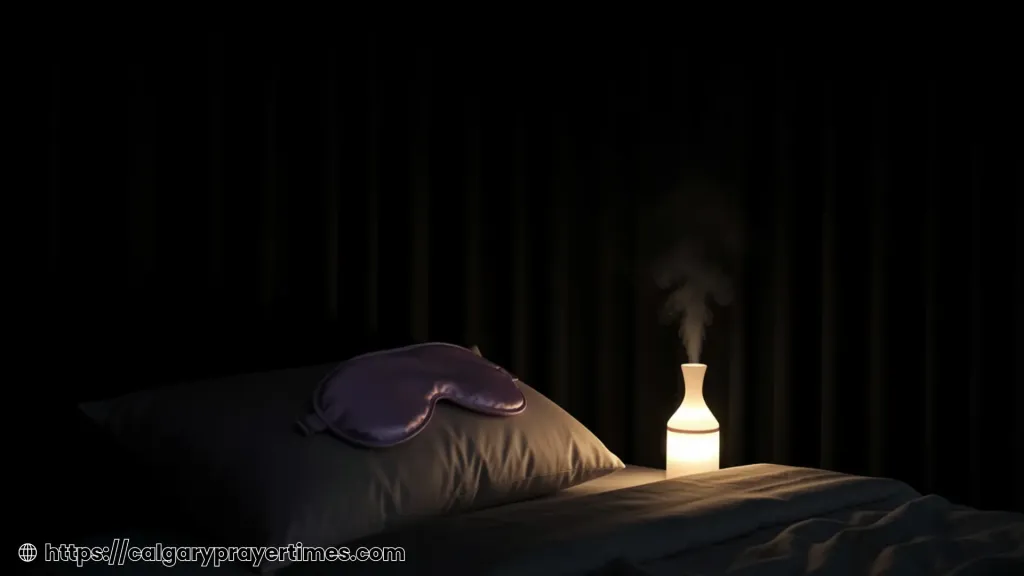
Blackout curtains or blackout blinds are the single most cost-effective bedroom upgrade for sleep quality. A sleep mask achieves the same darkness with greater portability. Tape over standby LEDs on electronics with black electrical tape. Remove or cover anything that glows. Your bedroom should be so dark that you cannot see your hand in front of your face; that is the standard that your melatonin system requires.
8. Use a White Noise Machine or Nature Sounds
Auditory disruptions are one of the most common causes of fragmented sleep, particularly in urban environments, shared housing, or households with children or pets. White noise (and its variants pink noise, brown noise, and the recently trending green noise) works by masking inconsistent environmental sounds with a consistent, non-threatening acoustic backdrop. The brain’s arousal system responds to a change in sound, not to volume itself. A sudden door slam wakes you, but consistent traffic noise eventually becomes ignorable. White noise exploits this by creating a consistent sound that prevents sudden changes from reaching conscious awareness.
9. Try Magnesium Glycinate Before Bed
Magnesium is involved in over 300 biochemical reactions in the body, and its relationship with sleep is one of the most thoroughly researched in nutrition science. Magnesium activates the parasympathetic nervous system, regulates melatonin production, and binds to GABA receptors, the same receptors targeted by benzodiazepine sleep medications, but through a gentler, natural mechanism. Magnesium glycinate is the form most associated with sleep improvement, as it combines magnesium with glycine, an amino acid with independent sleep-promoting properties.
Multiple randomised controlled trials show significant improvement in sleep onset time, sleep quality, and morning alertness in adults taking magnesium glycinate. It is one of the most consistently effective natural sleep supplements available.
10. Avoid Alcohol. It Destroys Sleep Architecture
Alcohol is one of the most commonly misused “sleep aids.” It does help people fall asleep faster, but it devastates sleep quality in the second half of the night. Alcohol suppresses REM sleep (the stage associated with memory consolidation, emotional regulation, and dreaming) and causes the body to cycle into lighter sleep stages repeatedly during the night. The result: you may sleep for 8 hours after alcohol and wake up feeling less rested than after 6 hours of alcohol-free sleep.
Even moderate alcohol consumption (one to two drinks) measurably reduces sleep quality. For people dealing with sleep problems, alcohol elimination even temporarily produces some of the fastest and most dramatic improvements in sleep quality reported in sleep medicine.
11. Use Your Bed Only for Sleep
Stimulus control therapy is one of the most evidence-based behavioural treatments for insomnia. The principle is straightforward: your brain learns associations through repetition. If you work from your bed, watch TV in bed, scroll in bed, or eat in bed, your brain associates the bed with wakefulness and stimulation, not sleep. This association can take months to form and can persist for years, making it genuinely harder to fall asleep in your own bed even when you are tired.
Use your bed only for sleep. If you cannot fall asleep after 20 minutes, get up, go to another room, do something calm in low light until you feel sleepy, then return. This breaks the bed-wakefulness association and rebuilds the bed-sleep association over one to two weeks.
12. Diffuse Lavender Essential Oil in Your Bedroom at Night
Lavender is one of the most extensively studied aromatherapeutic agents for sleep. Multiple clinical trials, including studies published in the Journal of Alternative and Complementary Medicine, have demonstrated that inhaling lavender before and during sleep significantly reduces anxiety, increases slow-wave sleep, and improves next-day alertness compared to placebo. The mechanism involves lavender’s primary compound, linalool, which binds to GABA receptors and produces mild, dose-appropriate sedation without dependence or tolerance.
Use an ultrasonic diffuser with 5–8 drops of pure lavender essential oil (not fragrance oil; check for “100% pure essential oil” on the label). Run it for 30 minutes before sleep and allow it to run while you sleep, or set a timer to stop it after you have fallen asleep.
🌙 Step-by-Step: Your 2-Week Sleep Hygiene Reset Plan
Don’t try to implement all 12 at once. Follow this sequence:
- Night 1–2: Set your wake time. Put your phone in another room. These two changes alone will begin shifting your sleep architecture.
- Night 3–4: Cool your bedroom. Hang blackout curtains or use an eye mask. Remove all LED standby lights.
- Night 5–6: Start your 20-minute wind-down ritual. Herbal tea, dim lights, no screens after 9 PM.
- Night 7–8: Set up your lavender diffuser. Add magnesium glycinate supplement (take 30–60 mins before bed).
- Night 9–10: Replace your phone alarm with a sunrise alarm clock. Use your bed for sleep only.
- Night 11–14: Eliminate afternoon caffeine, cut alcohol, and add a white noise machine if needed. By night 14, most people report a fundamentally different quality of sleep.
❓ Frequently Asked Questions
🌙 Your Best Sleep Is Waiting. It Starts Tonight
Save this post to your sleep boards and come back whenever you need a reminder. If you shop for any of the Amazon recommendations in this post, a small commission supports this blog at no extra cost to you. Thank you. 💙