
Simple Ways to Create a Calm and Peaceful Home Environment (That Anyone Can Do)
Simple Ways Create Calm, Peaceful Home. Because your home is either adding to your stress or reducing it, there is no neutral. Research from UCLA found that women who described their homes as cluttered or unfinished had higher cortisol levels throughout the day. Studies on hospital patient recovery have shown that even the view from a window, whether it overlooks a natural scene or a brick wall, measurably affects healing speed. Your environment shapes your nervous system every moment you are in it. Creating a genuinely calm home is not a luxury or an aesthetic preference; it is a health choice.
And crucially, a calm home does not require renovation, professional interior design, or a large budget. It requires the right decisions about light, clutter, colour, scent, sound, and natural elements. Here are the most impactful ones.
Why Your Home Environment Affects How You Feel
Your brain’s stress-response system, the amygdala, is continuously scanning your environment for potential threats and sources of cognitive load. Visual clutter, harsh lighting, chaotic sound environments, and environments that feel disordered or out of control all activate this system at a low level, maintaining a background state of mild alertness that is exhausting over time. A calm, ordered, visually simple, naturally lit environment consistently reduces amygdala activation, lowers cortisol, and supports the parasympathetic nervous system, the “rest and digest” mode that makes genuine relaxation possible.
The Most Impactful Changes You Can Make
1. Clear Every Visible Surface — Start With Just One Room
Visual clutter is the single biggest enemy of a calm home environment. Every item on a visible surface represents a micro-decision “should I deal with that? Should I move that? Does that belong there?” that the brain processes continuously, creating a constant low-level cognitive load. Clearing visible surfaces removes this load and immediately transforms how a room feels, even without changing a single piece of furniture or décor.
Start with one room, ideally the one you spend the most time in. Remove every item from every visible surface. Then only return the items that are genuinely necessary or genuinely beautiful. Anything functional that is not beautiful goes in a cupboard or a basket. Anything decorative that is not bringing you joy goes in a donation bag. What remains should be both intentional and calm. A beautiful set of natural seagrass storage baskets in three sizes makes hiding everyday clutter effortless. Remote controls, phone chargers, children’s toys, and magazines all disappear into something that looks intentional and stylish on any shelf or surface.
2. Switch to Warm, Soft Lighting Throughout Your Home
Lighting has a more immediate and more powerful effect on the felt atmosphere of a room than almost any other single element. Harsh, bright, cool white overhead lighting creates a clinical, high-alert environment. Warm, dimmed lighting at lower levels, 2700K colour temperature, placed in two or three floor or table lamps rather than one overhead source, creates an immediate sense of safety, warmth, and calm that the nervous system responds to within seconds of entering the room.
This does not require rewiring or new fixtures. Simply replacing your light bulbs with warm white 2700K equivalents and switching off overhead lights in the evening in favour of two or three warm lamps transforms the atmosphere of any room at minimal cost.
3. Introduce Natural Elements — Plants, Wood, Stone, and Water
Biophilic design, the principle of incorporating natural elements into living spaces, is one of the most research-supported approaches to creating calm environments. Humans evolved in natural settings, and the nervous system responds to natural materials and living things with measurably lower stress activation than to synthetic environments. Even a single indoor plant, a wooden bowl, a stone coaster, or a small glass of water with a flower floating in it introduces a natural element that the brain’s stress system registers as safe and calming.
The most accessible natural elements for any home: one or two easy-care indoor plants, a wooden tray or bowl on the coffee table, linen or cotton textiles instead of synthetic fabrics, and a small bowl of stones, shells, or dried botanicals as a centrepiece. None of these is expensive, and all of them collectively shift the felt atmosphere of a room.

4. Create Consistent Scent — One Signature Home Fragrance
Scent is processed by the olfactory bulb, which connects directly to the amygdala and hippocampus, the brain’s emotional centre and memory system. This means scent has a more immediate and more potent effect on emotional state than any other sensory input. A consistent signature home fragrance, one that you use every day in the same spaces, builds a powerful associative connection between that scent and the feeling of being home, safe, and relaxed. Over time, the scent alone triggers the calm response, even before you have consciously registered being in your home.
Choose one scent family for your home and use it consistently: lavender and eucalyptus for calm and clarity, sandalwood and vanilla for warmth and comfort, or citrus and fresh herbs for an energising but still grounded atmosphere. Use it through a diffuser, a soy candle, or a linen spray consistently and in the same rooms and let the association build over weeks.
5. Reduce Sound Clutter — Create Quiet Zones
Sound clutter background television, constant notification sounds, and multiple audio streams playing simultaneously are an invisible but significant source of stress in most modern homes. The brain cannot fully filter out background sound, even when you think you have tuned it out; it continues to process it at a subconscious level, maintaining a low-level state of alertness that prevents genuine relaxation. Creating designated quiet zones spaces in the home where screens are off, sounds are minimal, and the only audio is intentional provides the nervous system with genuine recovery opportunities throughout the day.
This does not mean silence is required. Gentle, consistent sounds, such as soft music you have chosen, rain sounds, birdsong, and a fountain, are calming because they are predictable and non-threatening. The harmful sounds are unpredictable, attention-demanding ones: notification pings, television news, phone calls on speaker.
6. Designate Spaces by Purpose — Keep the Bedroom for Rest Only
When spaces in your home serve multiple purposes, when the bedroom is also an office, a social media browsing zone, and a TV room, the brain loses the clear environmental cues that signal what mode it should be in. This is why people often struggle to switch off in bedrooms that double as workspaces. The visual and contextual cues associated with the room are mixed, and the brain cannot resolve them cleanly into a “rest” state. Designating spaces for specific purposes, the bedroom strictly for sleep and intimacy, a dedicated chair for reading, and a specific surface for work, creates environmental cues that make transitions between states faster, easier, and more complete.
7. Bring in Natural Light — Open Curtains Fully Every Morning
Natural light is the most calming and most energising light source available, and it costs nothing. A home that is flooded with natural light throughout the day feels immediately more spacious, more alive, and more optimistic, and the research supports this: natural light exposure during the day regulates serotonin production, supports circadian alignment, and is associated with lower rates of depression and better cognitive function. The simplest action: open every curtain and blind in your home fully within the first 20 minutes of waking, and keep them open throughout the day whenever privacy allows. A clean window lets in significantly more light than a dirty one. Include windows in your regular cleaning routine. Sheer natural linen curtains that filter daylight while providing privacy are one of the best investments in a calm, light-filled home. They make any room feel warmer, brighter, and more beautiful throughout the entire day, and they hang beautifully without any ironing required.
8. Keep Your Entryway Clear and Beautiful
The entryway is the transition zone between the outside world and your home. How it looks and feels as you cross the threshold matters more than most people realise; it sets your emotional tone for the entire time you are at home. A cluttered, chaotic entryway, with shoes everywhere, bags dropped on chairs, coats piled on one hook, and an unopened post accumulating, tells your nervous system that you are walking into disorder and low control. A clear, calm, beautiful entryway tells it you are walking into a sanctuary.
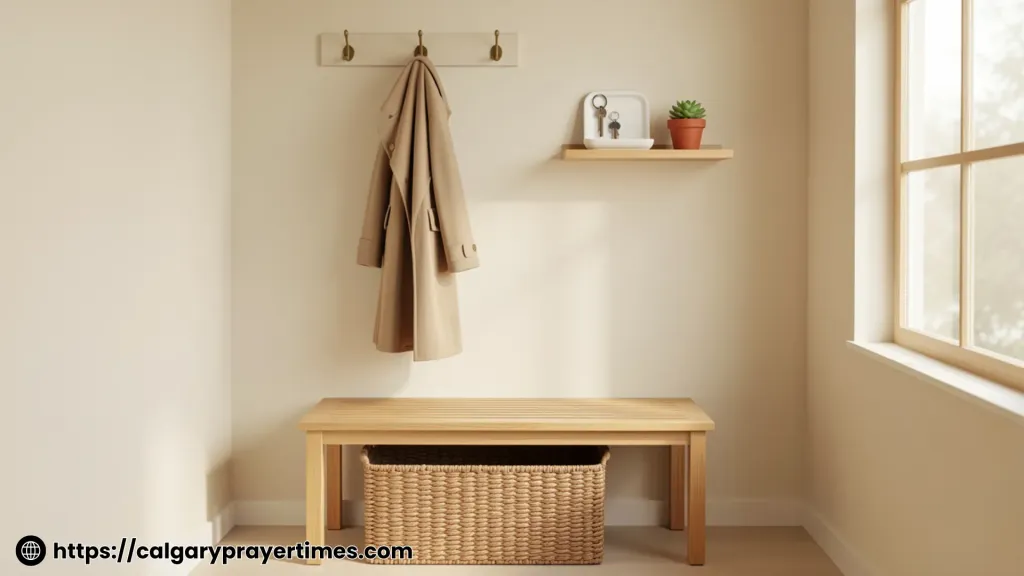
The entryway does not need to be large or expensive to feel good. It needs one place for shoes (a simple bench or shoe rack), one place for coats and bags (hooks at the right height), one surface for keys and post (a small tray or shelf), and one beautiful element, a plant, a small mirror, a piece of art, or a candle. That is all.
9. Do a 10-Minute Evening Reset — Every Night
The state your home is in when you wake up in the morning sets your psychological tone for the entire day. Walking into a kitchen with last night’s dishes, a living room with scattered cushions and surfaces covered in yesterday’s clutter, or a bedroom with clothes on the floor creates an immediate sense of being behind a mild but real burden that increases the perceived difficulty of everything that follows. A 10-minute evening reset, clearing all surfaces, replacing items to their homes, washing the dishes or stacking the dishwasher, plumping cushions, and briefly tidying the bedroom takes 10 minutes at most and transforms your morning experience completely.
10. Display Only What You Love — Remove Everything Else
Decor and objects that you feel indifferent to, that you keep out of guilt, or that are cluttering surfaces without bringing you any joy or serving any function are a constant low-level drain on your visual attention and emotional energy. They are not neutral; they are slightly negative, and slightly negative across an entire home adds up to a meaningfully less calm space. The principle is simple: only display what you genuinely love or actively use. Sentimental items that you feel obligated to display but do not love can be respectfully stored rather than destroyed, but they do not need to be in your daily visual field. A small set of neutral wooden display trays in three sizes makes intentional display effortless. When everything you choose to keep is arranged on one curated tray, it looks purposeful and calm rather than scattered across a surface.
🏡 Your Calm Home Action Plan — This Weekend
- Saturday morning: Clear all visible surfaces in your living room and kitchen. Only return what is necessary or genuinely loved.
- Saturday afternoon: Open all curtains and clean all windows. Replace light bulbs with warm white 2700K options.
- Saturday evening: Set up your signature home scent, a diffuser, a candle, or a linen spray in your main living space.
- Sunday morning: Tackle the entryway. One place for shoes, one for coats, one tray for keys, one beautiful element.
- Sunday afternoon: Add one natural element to each main room: a plant, a wooden tray, a linen cushion.
- Sunday evening: Do your first 10-minute evening reset. Notice how differently Monday morning feels.
❓ Frequently Asked Questions (FAQs)
🏡 Your Calmest Home Is Already Within Reach
Save this post to your home boards and come back to it whenever your space needs a reset. If you purchase through any links in this post, a small commission supports this blog at no extra cost to you. Thank you! 💚